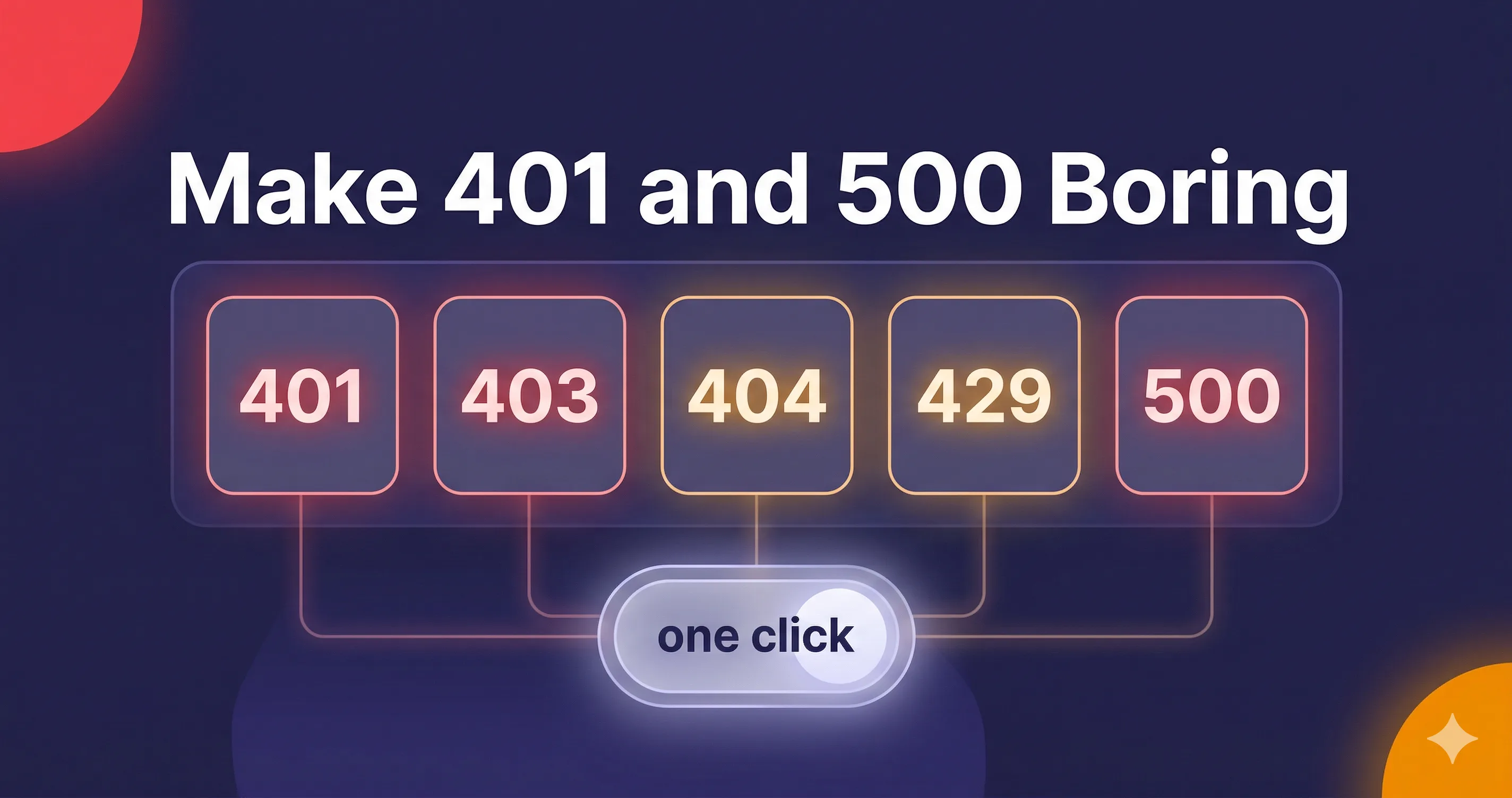

Testing the "happy path" of a long onboarding or checkout form is tedious, but straightforward. What happens, however, when the backend inevitably fails?
Forms exist to send data over the network. If you aren't testing how your UI handles missing tokens, gateway timeouts, and 500 internal server errors after the submission button is clicked, your error boundaries and fallback states are untested.
The problem? Triggering a reliable 500 error on demand from a real staging backend is incredibly frustrating. Waiting for slow networks takes patience most testers don't have.
This is where combining a one-click form filler with browser-side API mocking changes the game.
The Two-Extension Workflow
Testing failure states rapidly in the browser requires two complementary speeds:
- Input Acceleration: Getting the form populated instantly.
- Network Control: Forcing the backend API to behave erratically.
By using Mockfill (for generating realistic form payloads) in tandem with an API mocking tool (like Mockfill API Mocking), you can mock out entire error flows without touching a single line of backend or infrastructure code.
Scenario 1: The Unauthorized 401 Timeout
Imagine testing an admin dashboard that frequently boots users when their session expires mid-fill.
- Populate: Hit the Mockfill shortcut to populate all 25 fields of your intricate admin form perfectly.
- Intercept: Open your API Mocking extension and intercept the specific
POST /api/v1/update-settingsendpoint. - Mock: Configure the mock to return an HTTP
401 Unauthorizedstatus override. - Submit: Click submit on your UI.
Observation: Does the form silently swallow the error? Does a global toast pop up urging the user to log in again? Does the UI permanently trap them on a spinning loading wheel?
Scenario 2: The Brutally Slow 500 Server Error
Latency is unpredictable. If users impatiently spam the submit button, double charges can occur unless the UI correctly disables the input.
- Populate: Automatically construct a realistic payment payload utilizing the form filler.
- Intercept & Delay: Configure your API mocking tool to intercept the checkout route. Return a
500 Internal Server Error, but inject a deliberate 3000ms delay. - Submit: Click the button and watch the UI.
Observation: During those 3 seconds, does the button grey out? Does a loading spinner render correctly? After 3 seconds, does the form crash the entire application screen, or does an elegant error boundary handle the 500 response while retaining the form data?
Scenario 3: The Empty Payload Edge Case
Sometimes an API returns a 200 OK, but the response body is malformed or entirely missing, breaking dependent data renders on the subsequent success page.
- Populate: Auto-fill the form correctly.
- Intercept & Clear: Override the successful
200JSON response with a completely empty object{}using the API modifier. - Submit: Execute the submission.
Observation: If the success dashboard assumes an ID is returned response.data.id and it's missing, does the React/Vue component crash completely?
Speed Plus Control
Automation suites like Cypress or Playwright are fantastic for codifying deterministic error paths. But for rapid, tactile bug exploration on localhost or staging environments, there is no faster combination.
Use an intelligent browser extension to kill the tedious data entry, and use a network mocker to seize control of the backend. It guarantees your failure states are just as polished as your happy paths.